
25 photo journal ideas for days that do not feel eventful
You do not need a trip, milestone, or perfect photograph. Ordinary days are full of material once the prompt becomes specific enough.
The short version
- Specific prompts are easier than the broad question “How was my day?”
- A useful entry can be one photo, one detail, and two honest sentences.
- Recurring prompts reveal patterns without turning the journal into a tracker.
- Reviewing old pages is part of the practice, not an optional extra.
How to use this list without turning journaling into homework
Do not work through the ideas in order. Scan until one creates an immediate image in your mind. That small flash of recognition is the signal. Choose it, make one page, and stop.
You can also keep three prompts in rotation: one for a visible detail, one for a relationship, and one for change over time. A limited menu removes the nightly decision while leaving enough variation to stay curious.
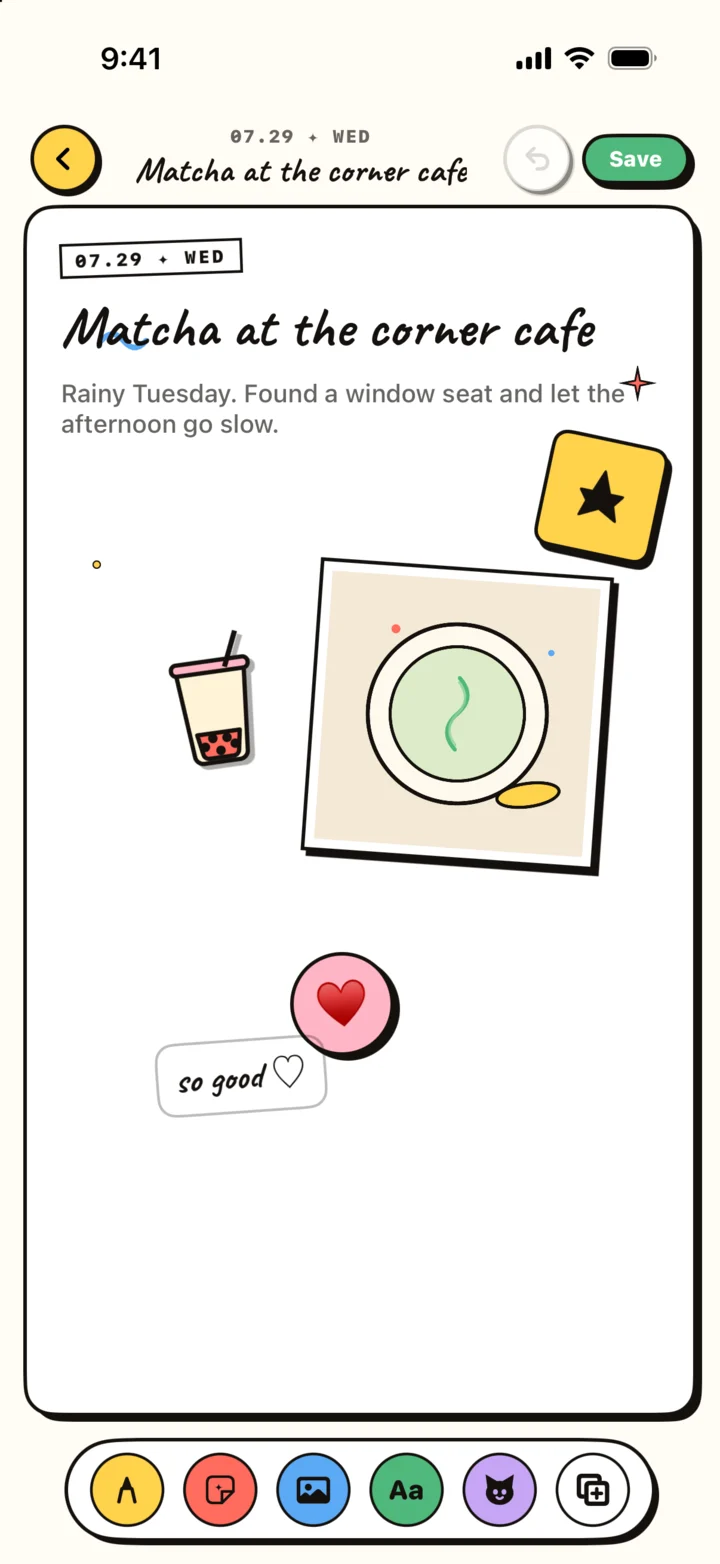
For each entry, begin with the smallest complete version: one photo, a concrete title, and two sentences. Add stickers or a more considered layout only when they help the memory read more clearly.
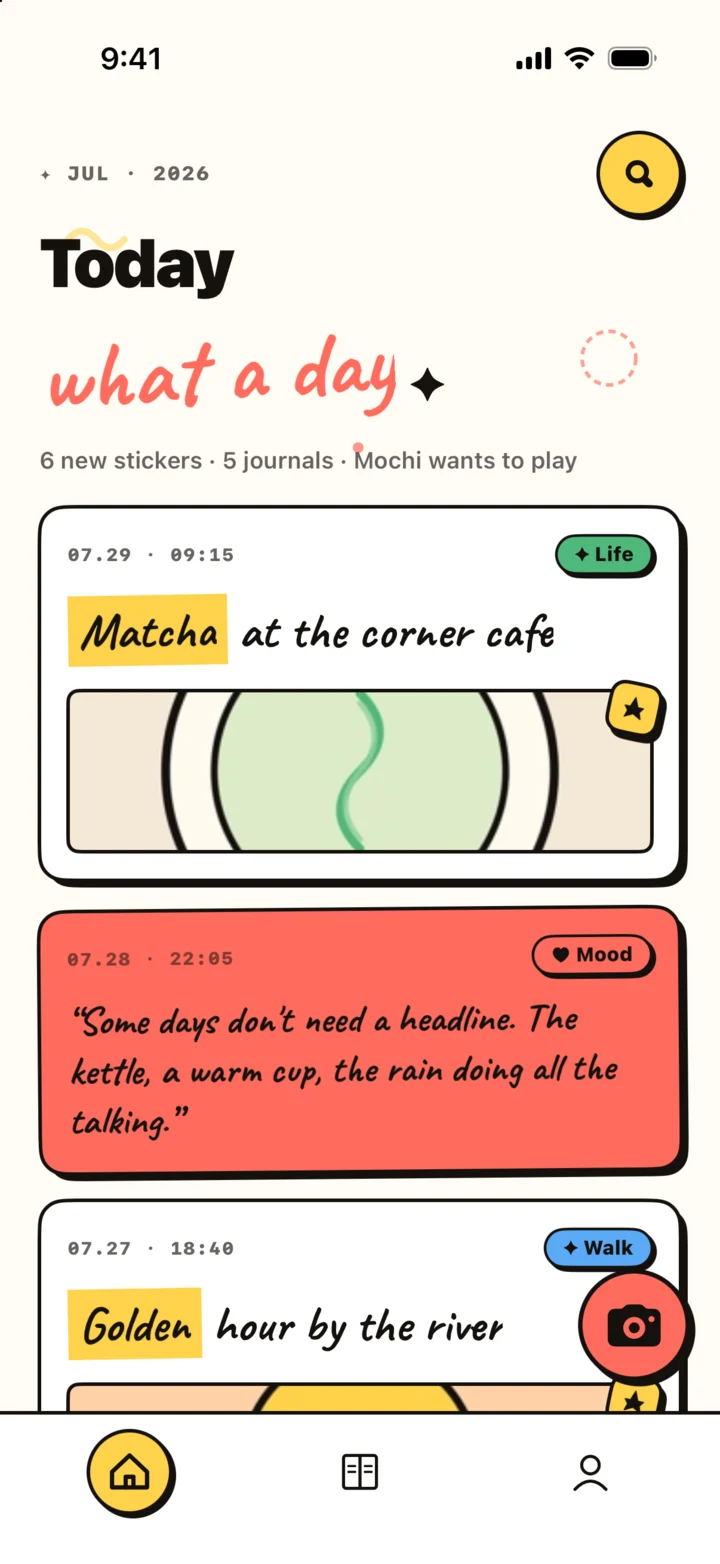
Create a complete small entry from one prepared photo: title it, add two lines, place one accent, and save.
Ideas 1–5: keep a small detail
Small-detail prompts work because they lower the stakes. You are not summarizing a life. You are paying attention to one thing that would otherwise vanish.
1. What was on the table?
Photograph the ordinary arrangement before it is cleared. Write who was there or what you were waiting for.
2. A color that followed you
Collect one color seen in clothing, food, signs, or light. Use it as the page accent.
3. The view from where you paused
A bus window, hallway chair, kitchen sink, or curb can locate the emotional pace of a day.
4. Something worn or repaired
Document the object that shows use. Write why you kept it instead of replacing it.
5. The smallest sign of the season
A first leaf, changed light, wet umbrella, or different fruit at the market is enough.
Ideas 6–10: remember a person without posing them
People do not always need to appear as portraits. Sometimes the better record is the evidence of their presence: a plate they made, a message on a scrap of paper, the book they recommended, or the empty chair after they left.
6. A sentence someone said
Use a scene photo and preserve the exact line that changed the mood.
7. A gesture of care
Photograph the tea, ride, reminder, or quiet task that made the day easier.
8. What you did side by side
Focus on the shared activity rather than a posed group photo.
9. An object that belongs to them
A familiar bag, mug, tool, or pair of shoes can hold a surprising amount of presence.
10. A person you missed today
Use a place or object that brought them to mind and write what triggered the memory.
Ideas 11–15: make familiar places visible again
Familiar places become invisible through repetition. Photographing them from a new position or at a specific time can restore attention.
11. Your usual route, one frame earlier
Take the photo before the landmark you normally choose. Record the transition instead.
12. A place before it opens
Morning setup, stacked chairs, or a closed door can reveal a different character.
13. The corner you always choose
Name why you return: light, sound, privacy, people-watching, or habit.
14. A useful local detail
Keep the shortcut, noticeboard, tiny shop, or machine that quietly supports your routine.
15. One block at walking speed
Photograph three textures and turn only one into a page. Selection is the point.
Ideas 16–20: record a ritual while it is still ordinary
Rituals often become meaningful only after they change. A recurring visual marker makes them easier to recognize across pages.
16. The first five minutes of morning
Photograph what happens before the day becomes public.
17. A meal you can make without thinking
Keep one ingredient or tool as a personal sticker for future cooking pages.
18. The work-in-progress surface
Show the desk, studio, counter, or floor before the project is tidy.
19. What signals the day is over
A lamp, closed laptop, walk, shower, or cup can carry the transition.
20. Your recurring small reward
Document the treat and write what it followed.
Ideas 21–25: notice what is changing
Change prompts do not require a dramatic before-and-after. The most useful comparisons are often subtle and spaced far enough apart that memory would otherwise smooth them over.
21. Something that became easier
Photograph the evidence and write what practice changed.
22. Something you are learning to notice
Keep one example now; future pages can reveal how your eye develops.
23. A room in transition
Record the half-finished state, not only the polished result.
24. The same view at a new hour
Pair it with an earlier memory or simply note what the light changed.
25. What future-you should not forget
Choose one precise fact from today and write directly to the person who will reread it.
Turn separate prompts into a journal you want to return to
At the end of a week, open the entries without evaluating your consistency. Notice which page brings back the most. It may not be the best photograph. Usually it contains one precise sentence or an unexpected detail.
Reuse the prompts that created those pages. A personal practice should become more personal over time. Delete the imaginary curriculum and keep the questions that help you see.
During a monthly review, choose one recurring subject and make a small collection page. Three café tables, four walks, or the changing work-in-progress can reveal a season without requiring a summary.
Browse recent entries, choose three related moments, and start a summary page around the recurring theme.